A good carp fishing setup does not need to be complicated. In fact, the most effective setups are often the simplest. When everything works together properly, you can focus on finding fish and fishing efficiently instead of managing gear.
This guide breaks down a complete carp bank fishing setup for fishing in the US. This information is based on a practical, minimalist approach. It is designed to work across rivers, lakes, and smaller waters where mobility and simplicity matter.
For anglers building a beginner carp fishing setup, this system covers everything needed to get started without overcomplicating the process.
This guide is not about individual pieces of gear, but how everything fits together into a complete and efficient day on the water.
The Core Idea Behind a Simple Setup
My goal for carp fishing is to maxmize my mobility, I fish with light gear and every piece of gear should serve a purpose without adding unnecessary weight or complexity.
A simple setup allows you to:
- move easily between spots
- set up quickly
- stay organized
- focus on location and bait
This approach works especially well when using easy carp fishing techniques that rely on proven rigs and bait presentation rather than complex equipment.
Rod and Reel Setup
The basics of any setup starts with the rod and reel. These two components should work together to provide balance, casting control, and enough power to handle large carp.
Shorter rods are often the better choice for bank fishing. They are easier to transport and more manageable in tight areas. I break this down further in my guide to best 9ft carp rods, which explains why shorter rods fit well into a mobile approach.
Reels should match the rod in both size and balance. Mid-sized spinning reels with a baitrunner feature are a reliable option for most situations. If you are unsure what to look for, my guide to best carp reels covers size, features, and practical options.
Line and Terminal Setup
Line plays a major role in both casting and fish control. Monofilament is a common choice because it is forgiving and easy to manage, especially for beginners.
Braided line can offer more sensitivity, but it requires more careful setup and handling. I explain the differences in detail in my guide to mono vs braid for carp fishing.
Terminal tackle should be kept simple. A basic rig, properly tied and presented, is more effective than overly complex setups. I always carry a extra method feeder weight or two, plus enough tackle in case I get snagged (swivels, wight stopper, etc.).
Rigs and Presentation
Rigs are where many anglers overcomplicate things. In reality, a few proven setups will work in most conditions. Remember, I fish in the US where carp fishing is not very popular and fish are rarely pressured. In Europe and other parts of world it’s a totally different ball game. They have to pay closer attention to detail because the fishing pressure means the carp can be much more weary to bite.
The hair rig remains one of the most effective and widely used carp rigs. It is simple, reliable, and works well with a variety of baits. The hair is the foundation of your baiting presentation. From there, you have tons of options that combine different baits and hooklink material. I’ll cover some of these options in a later article if you care to experiment a little.
The method feeder setup is another highly effective option. It combines bait and rig into a single presentation, making it one of the most consistent and easy carp fishing techniques available.
Keeping rigs simple allows you to fish confidently without constantly adjusting your setup.
Bait Strategy
Bait selection should match your fishing style and the waters you fish.
Simple baits like feed corn, tiger nuts and pack bait are widely used and consistently produce results. They are easy to prepare, affordable, and effective in many situations.
I cover these approaches in more detail in my guides to corn and boilies for carp fishing and pack bait recipes for carp fishing, both of which are commonly used in carp fishing in the US.
The key is not choosing the most complicated bait, but using something that carp will readily feed on where you live. This can vary by time of year as well, so some experimentation might be required. I find that corn is a good choice year round, but I will pair it with different boilies or baits to see what’s working on a particular day.
Rod Support and Setup
Rod positioning is another area where simplicity pays off.
Banksticks are often the most practical option for bank fishing. They are lightweight, adjustable, and easy to set up on uneven ground. Compared to larger setups, they allow more flexibility and quicker adjustments. If you’re trying to fish like me you want something light weight and easy to manage. An important tip is to always try to have your rods as parallel to the water as possible regardless what you choose as a support. This improves the chances of hooking a fish and makes better use of your bite alarms if you’re using them.
If you want a deeper comparison, I break this down in banksticks vs rod pods, which explains when each option makes sense.
Bite Detection
Bite detection can be as simple or as advanced as you want it to be.
Some anglers prefer to watch the rod tip and react visually. Others use alarms for added convenience, especially when fishing multiple rods or longer sessions.
As explained in my guide to carp bite alarms, these are helpful tools but not essential. The most important factor is being able to respond quickly when a fish takes the bait. I like using a cheap set of bite alarms because even when I’m not using them they can still be used as my rod support.
Carp Care and Landing Equipment
Landing and handling carp properly is an important part of any setup. While much of the focus is placed on rods, reels, and rigs, having the right equipment for landing fish ensures both safety and efficiency.
A large landing net is essential when targeting carp. Smaller nets can make landing fish difficult, especially when fishing from the bank. A wide net with a longer handle provides better control and reduces the risk of losing fish near the shoreline. A fine mesh net is preferred as carp have large scales that can be damaged when handling them.
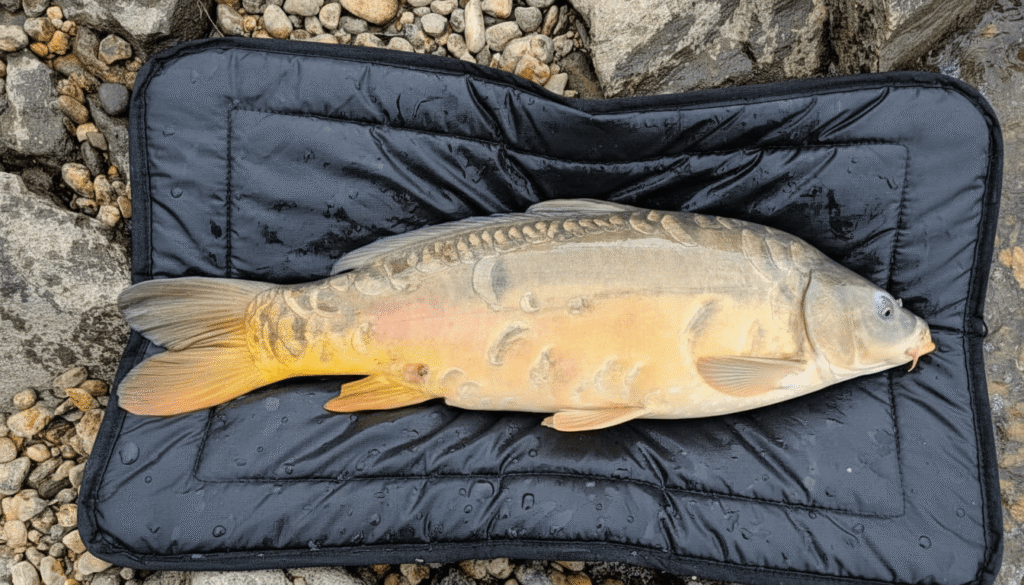
A landing mat is also highly recommended. This provides a safe surface for unhooking and handling carp, helping to protect the fish from injury. Many mats are designed to be lightweight and foldable, making them easy to carry as part of a mobile setup.
Basic tools such as pliers, line cutters, and a simple weighing setup can also be useful. These allow you to handle fish quickly and safely before returning them to the water. My weighing sling doubles as my landing mat so I don’t have to bring extra bulky gear.
Even in a practical setup, these items play an important role. They do not add much weight, but they significantly improve both fish care and overall efficiency when landing carp.
Carp are not like other fish species, they should never be handled by grabbing the mouth like you would with a bass, catfish etc. It’s best to hold them horizontally with one hand just in front of the forward fins and the other toward the end of the stomach/start of the tail. Carp are very solid fish and even the weight of smaller fish may surprise new anglers.
Mobility and Efficiency
One of the biggest advantages of my minimalist setup is mobility.
Being able to move quickly allows me to follow fish activity and adjust to changing conditions. This is especially important when fishing rivers or pressured waters.
Carrying less gear makes it easier to stay organized and spend more time fishing instead of managing equipment. If you can’t pack up in less than 10 minutes you might want to change up what you think you need to bring.
Putting It All Together
A complete carp bank fishing setup does not need to be complex. A balanced rod and reel, simple line and rigs, effective bait, and a practical support system are all that is needed.
By focusing on simplicity and efficiency, anglers can build a setup that works consistently across different waters and conditions.
For those new to the sport, this approach provides a clear starting point. For more experienced anglers, it offers a way to refine and simplify existing setups. Carp fishing in the US has gained some popularity in recent years thanks to organization like the American Carp Society and popular YouTube streamers.