Few freshwater fish generate stronger opinions in the US than the common carp.
Ask ten anglers what they think about carp, and you’ll probably hear words like “trash fish,” “invasive,” “destructive,” or “bottom feeder.” At the same time, carp are one of the most sought after sport fish across much of Europe, where anglers invest thousands of dollars in specialized equipment and spend days pursuing trophy-sized fish.
In other parts of the world they are prized for their meat and raised as food.
How can the same species have such completely different reputations?
Some criticisms of common carp are supported by decades of scientific research. Others have become accepted as fact simply because they’ve been falsely repeated for generations.
This article separates myths from what biologists, historians, and government agencies actually know.
If you’re new to the sport, you may also enjoy Carp Fishing in the US: How It Differs from Europe, which explains why carp fishing developed so differently on each side of the Atlantic.
A Note About This Article
Common carp are one of the most misunderstood fish in North America.
Many opinions about them are based on personal experience, local conditions, or stories passed from angler to angler. For this article, I’ve relied on information from fisheries agencies, historical records, and scientific research whenever possible.
There are links at the end for additional reading if you want to explore more.
| Common Carp Myth | Verdict |
|---|---|
| Common carp are the same as invasive carp | ❌ False |
| Common carp destroy every lake they live in | ⚠️ Partly True |
| Common carp destroy bass beds | ⚠️ Little evidence for direct bed destruction |
| Nobody eats carp, they are trash fish | ❌ False |
| Other carp species are a bigger problem than common carp | ✅ True |
How Common Carp Arrived in America
One of the biggest surprises people come to learn is that common carp were not accidentally introduced into the United States.
They were intentionally brought here.
In 1877, the U.S. Fish Commission began importing common carp from Germany and actively distributing them across the country as a food fish. At the time, officials believed carp would provide an affordable, hardy source of protein that could thrive in waters where native fish populations had declined. Millions of fish were eventually distributed to private ponds, farms, and public waters throughout the United States.
It’s almost impossible to imagine today, but the federal government once promoted common carp as one of America’s most promising food fish.
That historical context helps explain why common carp are now found in every state except Alaska.
Myth #1: “Common Carp Are the Same as Invasive Carp”
Verdict: False
This is probably the most common misconception in the United States.
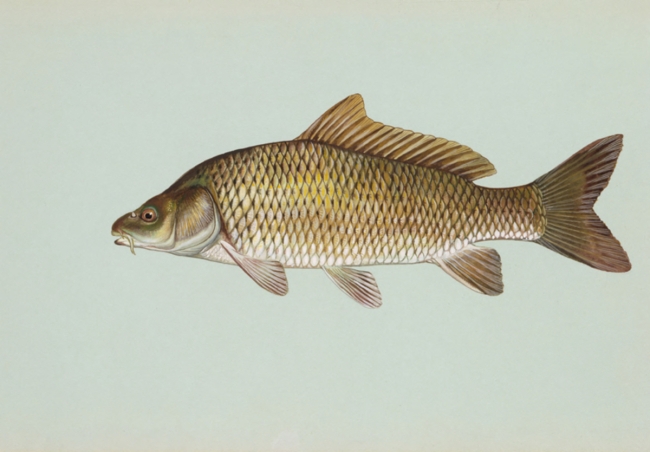
Common carp (Cyprinus carpio) are a completely different species from the fish now referred to by federal agencies as invasive carp, which include silver carp, bighead carp, black carp, and grass carp.
Those species were introduced much later, primarily during the 1970s, and spread rapidly through major river systems after escaping captivity. Their rapid reproduction and competition with native fish have made them the focus of extensive federal management efforts.
Common carp, by contrast, have been established in American waters for nearly 150 years.
That doesn’t mean they’re native, but it does mean they represent a very different ecological and management challenge. This distinction is why a lot of people improperly refer to them as invasive. Invasive in the sense they are not originally from here is true, invasive in the sense that they destroy every ecosystem is not fully true
If you’re curious about the different carp species anglers encounter, see Common Carp vs Mirror Carp vs Grass Carp.
Myth #2: “Common Carp Destroy Every Lake They Live In”
Verdict: Partly True
Researchers have clearly documented that common carp can uproot aquatic vegetation, stir bottom sediments, increase water turbidity, and reduce water clarity through their feeding behavior. Those impacts can be significant, particularly in shallow lakes with very high carp densities.
However, that does not mean every water body containing common carp becomes ecologically damaged.
Across the United States, there are abundant lakes, rives and reservoirs that support healthy populations of bass, bluegill, crappie, catfish, and common carp simultaneously.
The factors that really matter are:
- Density. How many carp are there for the size of the body of water
- Habitat. Lakes with extensive aquatic vegetation, stable shorelines, and diverse habitat may respond differently than shallow, vegetation-poor waters where carp have easier access to rooted plants and bottom sediments.
- Local conditions matter. Water depth, nutrient levels, the amount of aquatic vegetation, influence how much impact common carp have. Two lakes with similar carp populations can experience very different ecological effects depending on these conditions.
That’s a much more nuanced conclusion than the blanket statement that “carp destroy bodies of water.” This is especially true given that common carp exist in every US state except Alaska. For more information see my articles on Best States for Carp Fishing.
Myth #3: “Common Carp Destroy Bass Beds”
Verdict: Unproven – Lack of Evidence
This may be the most common claim you’ll hear from anglers, yet it’s also one of the hardest to support with scientific evidence.
During my research, I found no strong evidence that common carp intentionally seek out bass nests or actively feed on bass eggs as part of their normal behavior.
That doesn’t mean carp have no impact. Their habit of rooting through bottom sediments can disturb spawning habitat, increase water turbidity, and uproot aquatic vegetation. Those changes may indirectly affect bass spawning, particularly in shallow lakes where carp populations are unusually high.
But that’s a very different statement than saying common carp destroy bass beds which has not been proven. At this point, the research supports indirect habitat impacts far more strongly than intentional nest destruction.
Myth #4: “Nobody Eats Common Carp, Carp Are Trash Fish”
Verdict: False
This myth depends almost entirely on where you live.
Carp have been widely consumed in other parts of the world like Asia and certain parts of Europe for generations.
Even within the United States, many anglers still keep and eat carp, particularly within communities that have long culinary traditions involving freshwater fish. Remember that carp were originally introduced by the US government as a food source!
As refrigeration improved and other fish became more widely available, Americans gradually shifted away from eating carp. At the same time, recreational fishing increasingly focused on species like bass, trout, and walleye. Over time, carp became viewed less as a food fish and more as an unwanted bycatch.
You’ll also hear anglers who’ve never tried eating a carp say that they taste like mud. As with any fish, where you harvest the fish and how you process it have a significant impact on taste and texture. Carp are absolutely a tasty fish.
One of the actual truths here is that carp have a unique bone structure and are not easily fileted and eaten like other fish. Some anglers avoid eating carp for this reason.
Myth #5: “Other Carp Species Are A Bigger Problem Than Common Carp”
Verdict: Fact
Not all carp species have the same ecological impact.
While common carp (Cyprinus carpio) can negatively affect habitats by uprooting vegetation and stirring up bottom sediments, several other introduced carp species have caused far greater concern for fisheries managers.
Silver carp and bighead carp are filter feeders that consume large amounts of plankton, allowing them to compete directly with native fish for food. Silver carp are also well known for their tendency to leap from the water when startled by boat motors, creating a safety hazard for boaters.
Grass carp, although sometimes grouped with invasive carp, were intentionally introduced in many areas to control aquatic vegetation. In some waters they have provided a useful management tool, while in others escaped or reproducing populations have reduced aquatic plant communities beyond what managers intended. Their impact varies depending on whether sterile triploid fish or fertile fish are present and how they’re managed.
Unlike common carp, these species are the focus of extensive federal and state management efforts because of their potential to spread rapidly and disrupt native ecosystems.
The key takeaway is that “carp” isn’t a single type of fish. Different carp species have different feeding habits, behaviors, and ecological impacts, which is why it’s important to distinguish common carp from the invasive carp species often discussed in the news.
Why Europe and America See Carp So Differently
One of the most interesting discoveries while building Reel Practical has been seeing just how differently carp fishing developed on opposite sides of the Atlantic.
In Europe, carp became a destination species. Dedicated fisheries, specialized equipment, and catch-and-release ethics helped create an entire branch of freshwater angling centered around one fish.
In the United States, things look very different. Bass tournaments, trout stocking programs, and other game fish captured the attention of anglers while carp gradually fell into the background.t.
Today, however, that perception is beginning to shift.
More American anglers are discovering that common carp offer long, powerful fights, can reach impressive sizes, and are available in waters close to home without needing expensive travel or private memberships.
So…Are Common Carp Bad for American Waters?
The most honest answer is: Sometimes.
Common carp are not native to North America, but they are also not actively targeted by federal invasive species programs. Other species of carp that are actually invasive and destroying ecosystems are a much bigger threat to fisheries. This includes silver, bighead, and sometimes grass carp.
Common carp can negatively affect aquatic ecosystems, particularly where populations become extremely dense and habitats are already vulnerable.
Those impacts are well documented. At the same time, they have also coexisted with popular sport fish in countless American lakes and rivers for well over a century.
Final Thoughts
Few fish in North America have accumulated as many myths and a bad reputation as the common carp..
Common carp have been part of American fisheries since the late 1800s. They are neither the unstoppable ecological disaster they’re sometimes portrayed as nor a harmless species without environmental impacts.
They’re simply a non-native fish whose effects depend heavily on where they live and how many are present.
Whether you love common carp or wish they had never been introduced, understanding the science behind them is far more useful than repeating myths and that’s what good anglers should strive to do.
So Why Does This Matter?
Whether you enjoy catching carp or would rather fish for another species, understanding the difference between myths, opinions, and scientific evidence makes all of us better anglers. Fisheries management is complicated, and few fish illustrate that better than the common carp. The goal of this article wasn’t to convince you to like carp, it was to help you understand them.
Sources and Further Reading
- U.S. Geological Survey (USGS), What Are Invasive Carp?
- U.S. Geological Survey (USGS), Nonindigenous Aquatic Species Database: Common Carp (Cyprinus carpio)
- National Park Service, historical information on common carp introductions and management
- State fisheries agencies and university extension publications on common carp ecology and habitat impacts
- Peer-reviewed fisheries research on common carp, aquatic vegetation, turbidity, and freshwater ecosystem management